

Are you struggling to find the perfect Project Portfolio Management (PPM) solution for your organisation?
With pressure for faster and more flexible delivery and the need to capture work in real-time, our research shows that 89% of PMOs have inefficient systems and processes to allow them to do their job well. This is more pronounced for those using multiple tools, such as spreadsheets, SharePoint, and Teams, to communicate and manage projects. So, it’s no surprise that, according to Gartner, it can take two full-time employees (FTEs) over three business weeks to obtain information from these disparate tools, and reporting is often out of date by the time it gets to decision-makers.
In this and other examples, there is often a clear business case for a PPM solution, but understanding which one meets your organisation’s needs can be testing. Especially when you take a view of technical criteria, usability, interoperability, and total cost. In this report, we outline the considerations for you to confidently recommend a shortlist of vendors with PPM systems. We aim to help you manage an entire portfolio of work from one place, whilst giving stakeholders the real-time information they need to make decisions and to show your value.
But before you invest, you should answer two questions first: do you need a new PPM solution, and do you have the resources to maximise it?
Are you looking for a PPM solution?
There will be a time when you need to consider whether your processes align with your available technology and, if not, whether to update them or update the system. So, assess long-term goals against how new systems or applications connect to critical tools and will be used to help the business before you start.
Do you have the resources to maximise a PPM solution?
And remember, transferring bad data and processes makes any solution redundant, so taking time to improve all underlying components is important. What data do you have, where is it held, why do you need it, and how are you going to use it? What processes are in place, do they work, and can you standardise and improve them by automating documentation across the project’s lifecycle? Or can you use AI to identify ROI and preliminary benefits and to create tailored training packages to facilitate user adoption?
If your answers are ‘yes’ and you decide it’s the right time to go down the purchasing route, read on…
Assess your current needs and future requirements
Start with a half-day workshop with key stakeholders to understand the problems you’re trying to fix and gain clarity on the requirements from the start. You’ll need to build a business case that feeds into an organisation’s strategic objectives and quantify the ROI of a baseline not yet met, which is hard.
Map out your processes so you can make the system work for them, whilst simultaneously considering what the new system can do to help improve them – AI can do some of this work for you. And don’t forget to consider how to standardise them through documentation, communication, and training so the new system and processes are adopted and followed by the business correctly. Consider:
- Planning: do you require topline or detailed planning with tasks that have assignments underneath them?
- Timesheets: will you record time to understand how long critical task take like our customers Bettys & Taylors or not, like the IPO or ONS?
- Resourcing: do you need to have sight of incoming work as well as what is active in the portfolio to understand the resource demand and availability?
- Processes: are processes well defined, and embedded in the organisation, and do they follow the same methodology, or differ across project types?
The aim is to capture your current needs and future requirements. Focus on what you do now; review your Excel spreadsheets, SharePoint Lists, reports, visibility, and the planning engine, for example, and get to grips with what you could digitise to make things easier and better. Then ask where you want to be in three years-time with delivery. What doesn’t your current solution do for you now and how can these additional features help you to run your business if they were implemented?
If you need a work breakdown structure and simple task management for individual projects, then you’re after a Project Management solution.
Portfolio Management allows you to determine whether you’re focusing on the right projects, gives you visibility of all project work, and has a work intake process so you can manage resource capacity.
And if you want to track and manage your projects, programs and portfolios of IT and Business Change across your business to successfully deliver on your organisation’s strategy, then you need a Project Portfolio Management system.
The different types of PPM solutions
With the increasing complexity of project portfolios leading to significant changes in Project Portfolio Management (PPM), the sheer choice of solutions can be confusing. From SaaS to onsite, Project or Portfolio led or a combination of the two, being clear on your needs so you can narrow down your search is imperative.
We’d suggest buyers looking too big or too far into the future are likely to over complicate their processes and cripple user adoption, so consider if your PMO is level 3 or above in Gartner’s maturity matrix before deciding on an elaborate PPM solution.
Or begin with out-of-the-box solutions if you are one of the 80% of businesses that Gartner says are in the nascent stages of maturity. Smaller teams may benefit from one of the many SaaS products on the market, but if you have plans to scale quickly, watch out for the licensing fees, which become onerous very quickly, and cross-check integration, which isn’t always easy on these systems.
We recommend maximising any current license you have, such as Microsoft, Power Platform, and Copilot, which are ready to go, easily integrated into existing systems, simpler to ingrain into an organisation, and allow you to evolve through customisations when you require.
Technical criteria and interoperability
The first thing to check is whether company employees use different devices to access systems, or does everyone subscribes to a corporate build that is applied across the organisation. We would always recommend engaging with IT to understand what the internal and infrastructure costs would be to implement a solution. Especially, as some PPM solutions require specific infrastructure deployments with on-premises servers or cloud services. Vendors will provide these details.
Small PMOs of 1-4 people and businesses without multiple other systems that require integrating, could be better placed looking at a SaaS solution, like Monday.com. But a word of caution, if you are looking to scale and customise your solution iteratively, then really spend time on understanding the licensing and interoperability costs, as these can spiral quickly. If you already pay a license fee to use a common technology platform, such as Google Sheets or Microsoft 365, we’d recommend looking for vendors that can maximise your current investment.
Usability and adoption
The biggest risk of any IT deployment is that people don’t adopt it. You will need to understand the stakeholders’ current capabilities and garner support from champions to help embed the system and processes. So really think about how comprehensive and complex a PPM solution you need, right now, or whether a SaaS solution with no aftercare would be risky.
There is a middle ground. And it’s why we recommend Power Platform; you can build for your needs now and customise and add functionality iteratively, which means adoption is more fluid. And then maximise SharePoint, Co-Pilot, and Chatbots to tailor support modules so business champions can quickly see how a new application benefits their team and help drive adoption.
Total cost
Any PPM solution you recommend needs to save more than it costs, and considerations include licensing, implementation and set-up fees, training, and support. Further costs come from your own team’s time to adopt the solution, maintenance, and the hidden cost of replacing it, combined with poor team morale if your recommendation doesn’t work out. So, it’s important to engage with each potential vendor as soon as possible to understand their delivery model, the license impact, and potential rough order of magnitude (ROM) costs for Years one to three.
When assessing your costs, do look at areas that can spiral quickly without due diligence or even save on costs, such as licensing and implementation. For example, Toyota is one of the biggest customers of Microsoft in the world, meaning we could leverage the Licence costs that they are already paying to implement their PPM solution in Dynamics 365 and the Power Platform.
Licensing: There is a wide range of licensing cost models in the market, so check the terms with the vendor before committing. They range from cost per user per month to individual instances per month, and a one-off license cost. And some suppliers increase their license costs to you in years two and three, so get a longer license deal agreed upfront. Or look for solutions that make use of the licenses you already pay, such as ServiceNow or Microsoft.
Implementation: Although some solutions offer self-build options, many of them will need an experienced resource to set them up and configure them to your needs. So, most PPM systems will have an implementation cost – but there are different approaches vendors take. Some offer a fixed fee, some offer a consultative approach, and some deliver ‘big bang’ implementations.
We recommend focusing on the initial deployment benefits so you can justify the initial Minimum Viable Product (MVP) deployment. By starting small, you can commit to something low-cost but with maximum value. Then reflect and review and go forward with the learnings from the initial roll out.
Developing a vendor shortlist
When it comes to putting a shortlist together you will need to balance all your research thus far and consider what is most important to you. Most solutions will lean towards either usability with lean features, or broad functionality and reporting, and some market towards specific industries.
- Solutions that focus on visualisation and usability hierarchise user-friendliness, with good-looking visuals and very nice graphical representations.
- Functionality and reportability prioritises the freedom of functionality and data structures to easily allow the management of thousands of records.
- And others use industry-specific methodologies – think construction and engineering, for example – rather than using IT delivery in an iterative way.
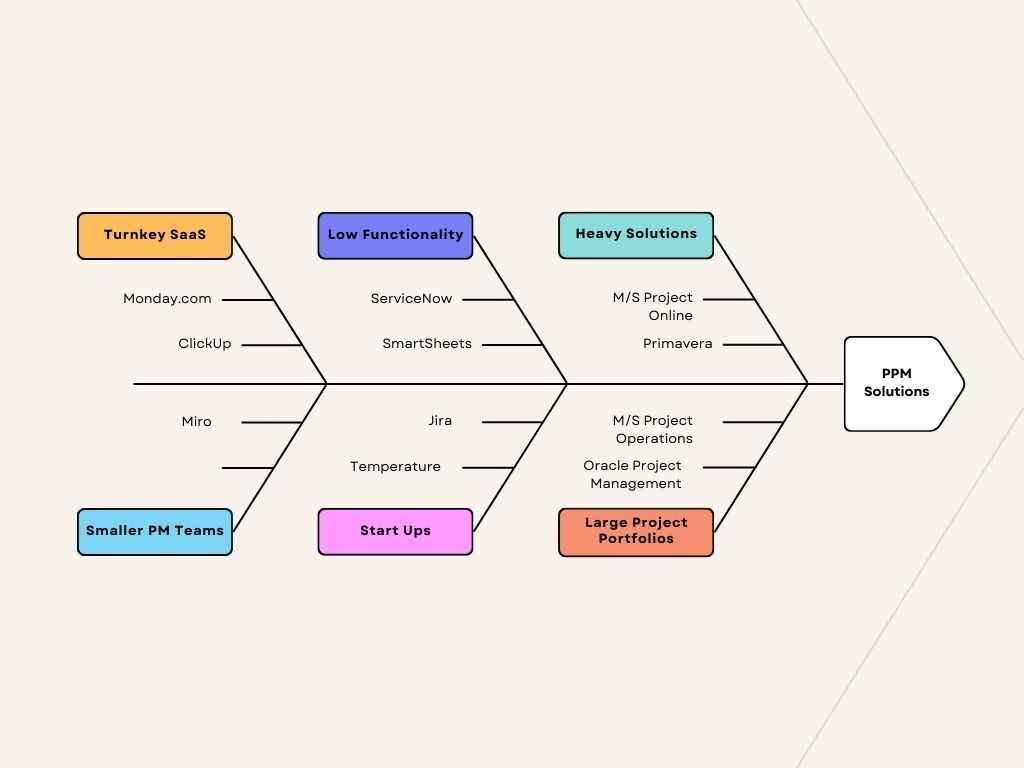
You’ll need to weigh up the pros and cons of a low functionality solution, turnkey Saas, or a heavy feature-rich solution. It’s worth noting that most PPM systems on the market align to one of these categories; none are drastically better than the other, but some will be a better fit for your organisation. Some examples are detailed in the diagram below, and we’ve outlined each category’s benefits to help you whittle your shortlist down.
- Low Functionality: these solutions are best suited to start-ups as they aren’t directly designed to operate as a Project Portfolio Management system, but can be tailored and used for some sort of PPM system if required.
- Turnkey SaaS: good choice to get up and running quickly because they’re easy to transact and have a great user interface and experience. They work best for a small team of Project Managers, but they don’t easily scale and configure with other products, and licensing costs can become expensive.
- Heavy Solutions: a good choice for large Project Portfolios within Construction, Engineering, or Enterprise Scale Delivery teams. These PPM solutions are powerful and comprehensive but are very expensive to set up and run, and can’t be configured quickly and iteratively.
However, there is another solution that doesn’t have the high costs of an Enterprise system and recognises one size doesn’t fit all – these are flexible and built iteratively to grow with your business needs:
Flexible Solutions: based on enterprise applications such as the Power Platform, but require configuration to meet the requirements of the user base. They are flexible, scalable, and adaptable to most needs across PPM, but take on an iterative approach to implementation.
This fourth solution is firmly where iCoTech sits.
Stress test your requirements
Look for vendors that can stress test your system requirements and build them iteratively so you can learn how this solution addresses the problems you clarified during the stakeholders’ workshop.
Start with something small of high value to test your MVP so you can gain stakeholder buy-in, and then build outward so the business can adapt to meet employees’ needs. No one wants the responsibility of recommending a new shiny system that has cost hundreds of thousands to find that nobody understands complex resource management, or that updating timesheets every thirty minutes is too much, or that the volume of risk notifications to stakeholders frustrates them and turns people off the system…
Start with something small of high value to test your MVP so you can gain stakeholder buy-in, and then build outward so the business can adapt to meet employees’ needs. No one wants the responsibility of recommending a new shiny system that has cost hundreds of thousands to find that nobody really understands complex resource management, or updating timesheets every thirty minutes is too much, or that the volume of risk notifications to stakeholders frustrates them and turns people off the system…
We hope this guide has been of some use and that if you require a Project Portfolio Management Solution, or you have delivered once recently that hasn’t gone to plan, you’ll reach out to iCoTech.
We have a brilliant team of Consultants who can support you in your PPM endeavors and we’re happy to talk you through how we have helped Toyota on its journey to implement a Work & Project Management Solution across their UK business, Oxfordshire County Council roll out a Project Portfolio Management Solution to 5 different departments, and the Intellectual Property Office build visibility of the complex Project Portfolio to the Board.
iCoPlan
Our accelerator, iCoPlan, sits across the Portfolio, Programme, and Project Management functions, giving you visibility and control of all data in your portfolios, allowing you to simplify how you work, deliver greater super user benefits, and offer project certainty.
By applying our knowledge and expertise to design innovative solutions that have structure and consistency, we give you more control over delivery, helping you to remain in scope, within budget, and on time. Our approach allows iCoPlan to deliver immediate value and desirable results at pace across your portfolio, programs, and projects, whether minor field changes or large-scale configuration for enterprise Portfolio Management in the Power Platform.
Looking to find out more?
Join iCoTech’s next webinar. Whether you’re evaluating options or starting your PPM journey, our webinar’s will provide you with knowledge and confidence.


