
Artificial intelligence is moving rapidly from experimentation to everyday business.
Across the Public Sector, organisations are exploring how AI can reduce administrative burden, improve productivity, identify risks earlier and help teams make better-informed decisions.
And the pace is accelerating.
80% of governments
Gartner, March 2026
It’s a striking prediction – and one that highlights how quickly AI is moving from experimentation towards practical application across government.
For us, it also raises a bigger question: is the data that will underpin those AI-enabled decisions ready?
That creates an important question for public sector leaders:
Is your organisation ready for AI, or are you simply ready to buy it?
There’s an important difference.
The organisations that gain the most value from AI are unlikely to be those that simply deploy the most tools. They will be the organisations that have built the information, governance and decision-making foundations that allow AI to work effectively.
AI is only as useful as the data behind it
AI can analyse data, identify patterns, summarise complex material and support people with increasingly sophisticated tasks.
But AI doesn’t magically solve poor data management.
What does this mean for portfolio delivery?
If projects are managed in one system, corporate risks in another, performance information sits in spreadsheets and financial data is held elsewhere, AI doesn’t automatically create a complete picture.
It can only work with the data and context it can access.
Imagine asking an AI assistant:
“Which of our major Programmes are most at risk?”
To answer that meaningfully, it needs more than a collection of Excel spreadsheets and PowerPoint presentations.
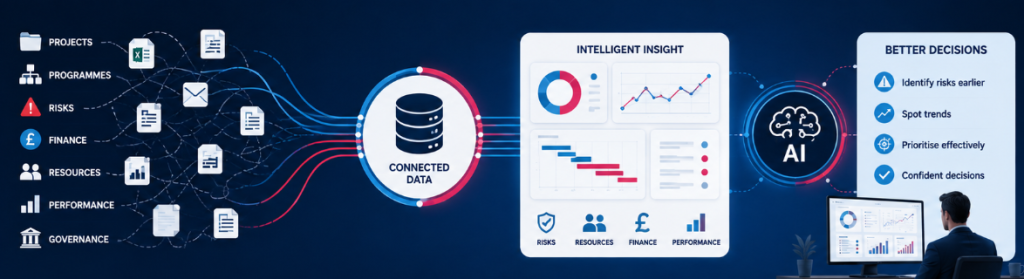
It would need to understand:
- Current project & programme milestones
- Budget and financial performance
- Risks and issues across multiple Programmes and its associated Projects
- Dependencies between the Programmes
- Resource forecasts and availability
- Programme benefits to be delivered
- Strategic priorities across the business
- Previous status reports for the Programme and Projects
- Governance decisions made recently
- Changes in scope or delivery confidence being reported
- Audit trails and logs
If that data is scattered across spreadsheets, documents, emails and disconnected systems, the AI may only see part of the picture.
And a partial picture can produce a confident answer that is still wrong.
That is why AI readiness starts with data readiness.
Why this matters in the public sector
For public sector organisations, the consequences of poor data go beyond internal productivity.
Local authorities, government departments, police forces and NHS organisations make decisions that directly affect communities, services and the use of public money.
Leaders need to be able to explain:
- Why a decision was made
- What information supported it
- Where risks sit
- Whether programmes are delivering their intended outcomes
- Where resources are being allocated
- What has changed since the last governance review
This makes trusted and accurate data fundamental to good governance.
It also makes AI governance different from simply governing a technology platform.
As AI moves towards increasingly autonomous decision-making, organisations will need to understand not just how an AI system works, but what data is influencing the decisions it supports.
The same Gartner research predicts that by 2029, 70% of government agencies will require explainable AI and human-in-the-loop mechanisms for automated decisions that affect citizen service delivery.
The message is clear:
Automation cannot remove accountability.
If anything, it makes the quality and traceability of the data behind decisions even more important.
AI adoption in government is already moving beyond small-scale experimentation. A cross-government Microsoft 365 Copilot experiment involved 20,000 employees across 12 government organisations, with users reporting an average time saving of 26 minutes per day.
But the same government research also highlighted the importance of keeping information and knowledge management practices up to date – reinforcing the need to get the foundations right before AI is deployed at scale.
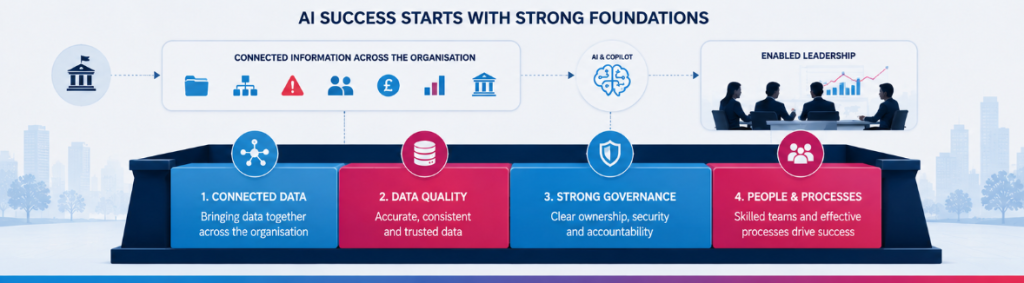
Four foundations for AI-ready decision-making:
Becoming AI-ready doesn’t necessarily mean starting with a new AI platform.
In many organisations, the first step is getting more value from the data and systems already in place.
1. Connected Data
Projects, Programmes, Risks, Performance, Resources and Finances each tell part of the organisational story.
The challenge is connecting those pieces.
A connected data environment allows leaders to see relationships between them rather than reviewing each area in isolation.
For example, a Programme showing as “green” might look healthy until its associated Corporate Risks, Resource Constraints and Benefit realisation plans are considered.
Connecting the data provides the context needed to turn individual data points into meaningful information.
And context is what allows AI to move from simply retrieving data towards providing useful information and insight.
Recommendation 1: Connect the data
Bring relevant project, programme, risk, resource, financial and performance data together so AI has the organisational context needed to produce more meaningful insight.
2. Data Quality
AI doesn’t remove the need for data quality.
It increases it.
If two departments use different definitions of “at risk”, if project information hasn’t been updated for six weeks, or if spreadsheets contain conflicting figures, users will understandably question anything AI produces from that information.
Trusted AI therefore starts with trusted data.
That means establishing:
- Consistent definitions
- Clear ownership
- Defined data standards
- Appropriate validation
- Regular updates
- Clear audit trails
The goal isn’t necessarily perfect data. It’s data that is sufficiently accurate, consistent and governed to support the decisions being made.
Recommendation 2: Create a common data language
Establish a clear data dictionary with consistent definitions across the organisation, helping systems and people interpret information in the same way.
3. Strong Governance
Governance is sometimes viewed as a barrier to innovation.
For AI, it should be viewed as an enabler.
Good governance establishes who owns data, who can access it, how decisions are made and how exceptions are handled.
This becomes particularly important as organisations move from AI assistants towards AI agents capable of taking actions or automating parts of a process.
The UK Government is already developing guidance and resources around safe and responsible AI adoption across the public sector, including skills, governance and access to appropriate knowledge, data and tools.
Recommendation 3: Establish clear ownership and governance
Define data ownership, security roles, access and governance standards, making appropriate use of Microsoft 365 security, governance and access capabilities.
4. People and Processes
Technology alone doesn’t create better decisions.
People need to understand how data should be captured, maintained and used.
Processes need to support the people in completing actions and procedures.
Governance needs to reinforce the importance of accurate information.
And teams need the skills to challenge AI outputs rather than automatically accepting them.
The strongest AI strategies therefore combine technology with people and process.
Recommendation 4: Invest in people and processes
Make sure people are appropriately trained to use and challenge AI effectively, supported by clearly defined processes for capturing, maintaining and governing data.

EXPLORE THE RESEARCH
Exploring the Copilot Journey Across the Public Sector
Discover what public sector leaders told us about Copilot adoption, the challenges they’re encountering and the foundations organisations need to put in place for successful AI adoption.
What this looks like in practice
These principles aren’t simply about preparing for some distant AI-enabled future.
Across iCoTech’s customer base, organisations have already been addressing the underlying data challenges that AI makes increasingly important.
At Neath Port Talbot County Borough Council, for example, bringing project information into a more structured portfolio environment has helped create a central view of projects and reduce the effort involved in producing portfolio reporting.
The important point isn’t the technology itself.
It’s the foundation that has been created.
A consistent structure. A common source of information. Better visibility. Greater confidence in the data.
The same principle applies in different ways across organisations such as South Wales Police and Digital Health and Care Wales (DHCW), where portfolio and programme environments need to support complex organisations, multiple stakeholders and significant governance requirements.
These aren’t AI projects – and that’s precisely the point.
Organisations don’t need to implement AI first to become AI-ready.
They need to address the data, governance and decision-making challenges that AI will eventually sit on top of.
Start by creating better visibility of the data you already have
AI readiness doesn’t necessarily start with an AI implementation.
For many public sector organisations, it starts by creating a more connected, trusted view of the projects and programmes they’re already delivering.
If fragmented information, manual reporting or limited portfolio visibility is a challenge you’re currently facing, book a consultation with one of our team.
We can discuss your current approach, the challenges you’re experiencing and how you could create a more connected view of portfolio performance using the Microsoft technologies you already have.
The takeaway
AI readiness isn’t about having the latest AI tool.
It’s about having the data, governance and organisational context to make that tool useful.
And that work can start today.


