

Microsoft has announced the retirement of Project Online, with the service closing permanently on 30th September 2026. New licence sales ended on 1st October 2025. Once the platform is switched off, all data stored in Project Online, including schedules, RAID logs, timesheets, SharePoint lists, governance documentation and reporting data, will no longer be accessible.
For public sector organisations, this change represents a major shift. Many teams rely on Project Online for project governance, reporting cycles, audit trails and strategic portfolio management. During the recent Microsoft & iCoTech Project Online End of Life Webinar, attendees raised questions about data extraction, timelines, procurement constraints and alternative tools.
This blog summarises what’s changing, the potential risks, and the options available to public sector organisations going forward. It also highlights iCoPlan as one of the solutions already chosen by several UK local authorities, while recognising it as one option among a wider range of approaches.
Why is Project Online ending?
Project Online is built on legacy SharePoint architecture that can’t keep up with:
- Modern Microsoft 365 integration
- AI-driven tooling
- Advanced reporting requirements
- Cloud-first performance and scalability
Microsoft is instead investing heavily in:
- Planner Premium
- Microsoft 365 Copilot
- Project Manager agent
While these tools are modern and collaborative, many public sector PMOs have noted that they do not offer like-for-like replacements for structured governance, portfolio management, RAID management or complex reporting.
Key retirement dates
|
Milestone |
Date |
|---|---|
|
End of new Project Online sales |
1 October 2025 |
|
Project Online retirement |
30 September 2026 |
What’s at stake for public sector organisations?
1. Loss of access to governance data
From 30 September 2026 onwards, organisations will permanently lose access to:
- Schedules
- Audit trails and logs
- RAID data
- SharePoint lists linked to PWA
- Timesheets
- PWA project pages
This creates substantial compliance and audit risks, especially for organisations required to retain project or programme records.
2. Operational disruption
A last-minute migration may disrupt:
- Quarterly reporting cycles
- Programme governance boards
- Scrutiny and assurance processes
3. Rising migration costs
Migration costs can increase by 15/20% per quarter if organisations delay, driven by increasing data volumes, technical debt and time pressure.
Migration timescales
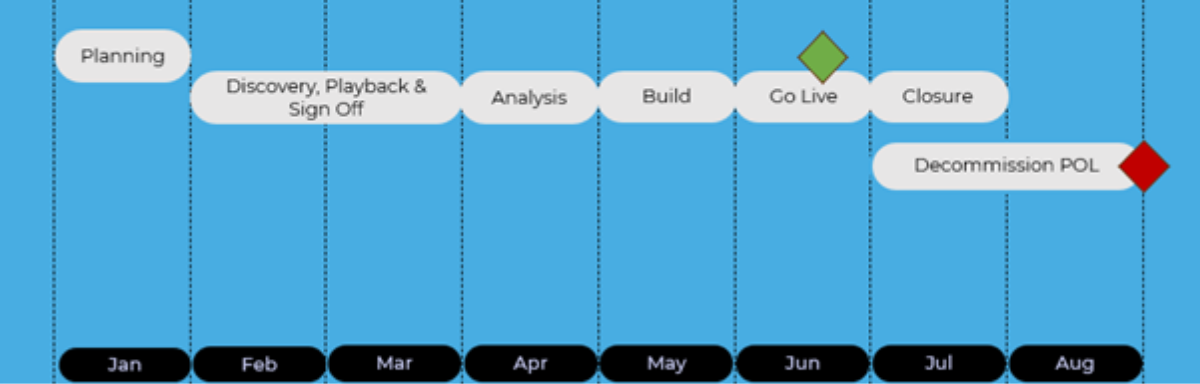
Below is a timeline outlining our recommended approach for organisations currently using Project Online, based on a full migration to iCoPlan.
Migration options
Every organisation is different. Through our Discovery Workshops, we assess your current environment and work with you to determine where you sit on this complexity scale.
For data migration, choosing to load historical data into the new solution will automatically place your migration in the High Complexity category.
Our recommended approach is to retain the final extract from Project Online in an SQL database and use Power BI to report against this historical dataset. This ensures continued access to historical information without adding unnecessary complexity to the new platform.
There will always be variations between these scenarios, but they provide a clear framework to support planning and decision-making. As expected, higher complexity directly impacts both the cost and duration of the migration.
|
Low |
Medium |
High |
|
|
|
|
Manual Data Upload |
Automated Data Upload |
Historic Data Upload |
iCoPlan: An option favoured by UK local authorities
While multiple solutions exist, many UK councils and public sector organisations have already selected iCoPlan as their preferred replacement for Project Online. Reasons commonly cited include:
- Familiar governance and reporting structures
- RAID, milestone and portfolio visibility
- Robust Power BI integration
- Seamless use of existing Microsoft 365 licences
- Alignment with public sector assurance and scrutiny needs
iCoPlan is not the only choice, but it is a proven, sector-aligned option that mirrors many Project Online capabilities while offering a modern user experience.
Complementary accelerators in the iCoTech Suite
- iCoRisk: Public‑sector‑aligned risk & control management
- iCoView: Real-time portfolio dashboards and insights
- iCoHelp: Your intelligent assistant, automating tasks and improving productivity across the iCoTech suite
What we heard in the Webinar: FAQs
How long does migration take?
Typically, 5–6 months for delivery, with overall timelines influenced by governance and procurement processes. Thanks to the way the system is built, this can still be achieved comfortably ahead of the changeover deadline.
Will SharePoint lists still be accessible?
No – PWA-related lists and pages will no longer function.
What happens to reporting?
Dashboards need rebuilding, ideally in Power BI.
Migration best practices
- Audit your current environment – projects, templates, integrations
- Export Project Online data early – schedules, RAID, lists, timesheets
- Define your future governance model
- Evaluate all tools objectively – Microsoft options + iCoPlan
- Rebuild reporting ahead of time to avoid gaps
- Pilot the new solution with a representative cohort
- Roll out in phases for smoother adoption
Working with iCoTech
iCoTech has helped multiple public sector organisations navigate Project Online retirement by providing:
- Data extraction support
- Options appraisal & selection workshops
- Migration planning and delivery
- Implementation of iCoPlan when chosen
Importantly, iCoTech supports organisations regardless of which future solution they choose.
Key takeaways
- Project Online retires on 30 September 2026 – plan early.
- Multiple replacement options exist; each has pros and cons.
- iCoPlan is one proven option, already selected by several local authorities.
- Early reporting rebuilds and data exports reduce risk.
- A structured migration ensures continuity, compliance and confidence.
A practical migration & modernisation playbook
If you enjoyed this article and would like to gain a further understanding of how you and your organisation can navigate the change of Project Online retiring later this year. We have designed a helpful playbook to provide further guidance and information on migration.


